The importance of a healthy spine
During the next few days, I’m going to be looking at the importance of a healthy spine – something that is a key element of Dru Yoga.
Over 2,400 years ago, the physician Hippocrates (460-360 BC) said “look well to the spine as the cause of all disease”. Centuries later, the vital role of the spine in holistic health is still incontrovertible. So, how is a healthy spine achieved and why is it so important to our well-being? In order to answer these questions, we first need to explore the spine’s structure and function.
The skeletal structure of the spine
The spine (or vertebral column) is a flexible support made up of bones, known as vertebrae, and is divided into five regions: cervical, thoracic, lumbar, sacrum, and coccyx (Figure 1).
Figure 1: The Spine
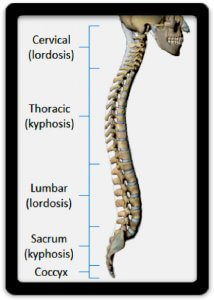
The cervical region of the spine provides support to the skull and allows the neck to move, whereas the thoracic area holds the ribs in place and strengthens the rib cage 1. Most of the body’s weight is supported by the lumbar spine 1 and this region is particularly prone to pain 2.
The undulations of the spine are known as lordosis (inward curve) and kyphosis (outwards curve). Lordosis is observed in the cervical and lumbar regions, whereas kyphosis is thoracic and sacral (Figure 1) 2,3. These curves arch the spine backwards and forwards across the central line of gravity, allowing the weight of the head and torso to be distributed 2,3.
In perfect posture, the spine is aligned so that a straight line exists between the ear, shoulder, hip, knee, and ankle (Figure 2) 2,4.
Figure 2: Perfect posture
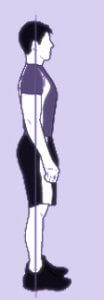
Perfect posture is important as the four natural curves of the spine (cervical lordosis, thoracic kyphosis, lumbar lordosis, and sacral curve) help distribute weight during physical activity 4, such as walking 2. Lumbar lordosis allows humans to walk upright – without it we would be unable to walk on two legs for very long 3.
Tomorrow, I’ll take a look at an important part of the spine – the vertebrae!
References
- Abrahams PH. How the Body Works. London: Amber Books; 2012.
- Key S. Sarah Key’s Back Sufferers’ Bible. London: Vermilion; 2007.
- Kaminoff L, Matthews A, Ellis S. Yoga Anatomy. Champaign, IL: Human Kinetics; 2007.
- Sullivan K, Royal College of General Practitioners. 5-minute Back Relief. London: Collins; 2007.