Introducing the vertebrae
Our spine is an amazing structure! Yesterday, I looked at the overall structure of the spine and promised I would blog about the vertebrae…so here we go!
Vertebral structures
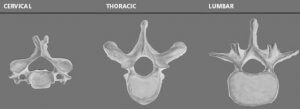
There are 33 vertebrae in the spine, of which 24 are articulating (movable) and nine are fused (in two segments). The articulating vertebrae make up the cervical, thoracic, and lumbar regions of the spine and the fused segments comprise the sacrum and the coccyx. The vertebrae in each region vary in number and appearance (Figure 1); cervical (seven vertebrae, C1-C7), thoracic (12 vertebrae, T1-T12), lumbar (five vertebrae, L1-L5), sacrum (five fused vertebrae), and coccyx (four fused vertebrae) 1,2.
Figure 1: Cervical, thoracic and lumbar vertebrae
The vertebrae are held together by ligaments and attached to the muscles by tendons 3,4. Between articulating vertebrae are gel-like intervertebral discs which act as shock absorbers in response to changes in weight load (Figure 2) 3,4. The discs are avascular (have no blood supply) and therefore need to obtain nutrients via alternative means 2. In addition to diffusion, large spinal movements help to nourish the discs. When the spine moves, compression and suction of the discs pushes fluids in and out of the capillary beds of the vertebral bodies which provide the discs with nutrients (Figure 2) 2. This highlights the importance of movement in the maintenance of disc health.
The segments of the spine are linked together by two facet joints at the back of each articulating vertebra 2. Facet joints, in combination with the discs, allow the spine to bend and twist (Figure 2) 4.
Figure 2: Vertebral structure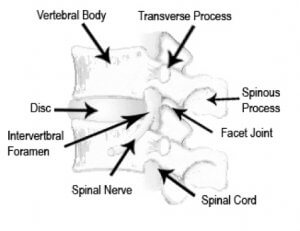
The space in each vertebra forms a channel down the length if the spine that protects the spinal cord 4. A total of 31 pairs of nerve roots branch from the spinal cord through the vertebral spaces and make up the peripheral nervous system (Figure 2). If good spinal health is not maintained, these nerves may not emerge from the vertebral spaces correctly and can be impinged by muscles, vertebrae or discs – potentially causing pain 4.
Now we have looked at the skeletal structure, tomorrow, I’ll start to explore the musculature of surrounding the spine.
References
- Abrahams PH. How the Body Works. London: Amber Books; 2012.
- Key S. Sarah Key’s Back Sufferers’ Bible. London: Vermilion; 2007.
- Kaminoff L, Matthews A, Ellis S. Yoga Anatomy. Champaign, IL: Human Kinetics; 2007.
- Sullivan K, Royal College of General Practitioners. 5-minute Back Relief. London: Collins; 2007.